Automation Framework or Automation Tool - What the American Tech Industry Needs in 2026

“The United States doesn’t just build software, it sets the pace for how software is built globally.”
From Silicon Valley startups to enterprise SaaS companies in New York, Seattle, Austin, and Chicago, the US tech industry has always been defined by speed, scale, and innovation.
But as we move into 2026, that speed is colliding with an uncomfortable truth:
With speed, the robustness of the SDLC and STLC are tested. The agile methodologies are tangled and challenged by AI.
Traditional test automation practices can no longer keep up the pace of modern release velocity.
Till now, engineering teams have been debating whether an Automation Framework or a Test Automation Tool is the right foundation for quality at scale. Frameworks promised flexibility and control. Tools promised speed and simplicity.
In 2026, that debate has shifted.
The question is no longer “Which is more powerful?”
It is now “Which helps American tech teams ship faster, safer, and smarter without increasing costs?”
This blog portrays why the US tech industry is in need of scalable automation. It also discusses AI, and how No-Code automation tools differ from Automation Frameworks.
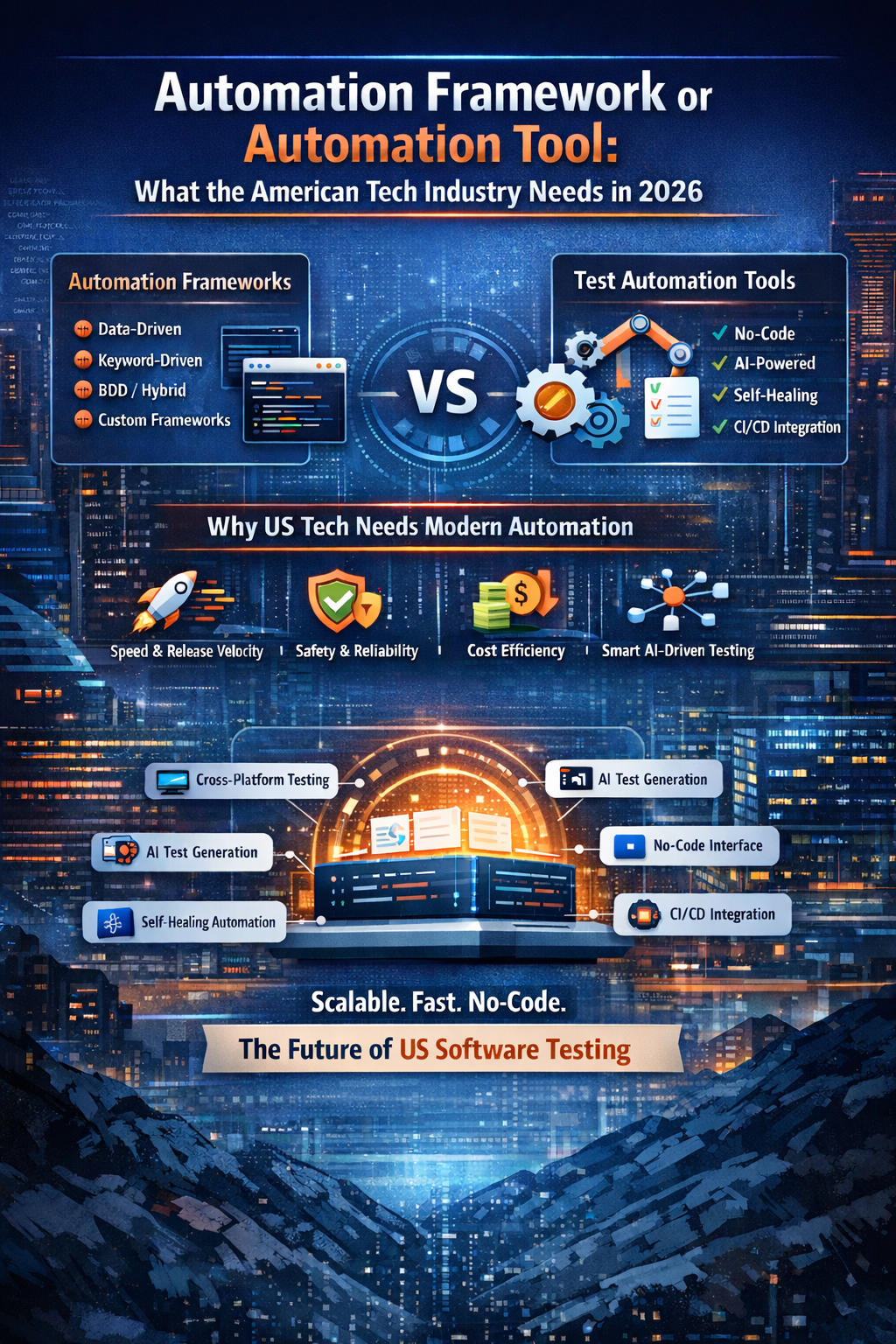
Why the US Tech Industry Needs Modern Automation in 2026
In the United States tech market, release velocity is no longer an engineering metric. It is a core business requirement. SaaS companies, fintech platforms, health-tech innovators, and e-commerce leaders tend to deploy weekly and in many cases daily releases to stay competitive.
Continuous delivery is no longer aspirational; it is expected by customers, investors, and internal stakeholders alike. In this environment, even a few minutes of downtime or a production regression can result in lost revenue, breached SLAs, regulatory exposure, and long-term damage to brand trust.
Traditional manual testing processes and brittle, script-heavy automation frameworks struggle to keep pace with this speed.
They introduce bottlenecks, delay feedback loops, and increase the risk of escaped defects. To sustain modern release velocity without sacrificing reliability, US tech companies require intelligent, scalable, and automated testing approaches that can validate quality continuously—without slowing down innovation.
Incorporation of Agile + STLC with the Help of AI & Automation
Modern American tech teams operate in an environment where Agile development and DevOps are deeply connected. Thus, transforming the way in which the Software Testing Life Cycle (STLC) is executed.
Instead of treating testing as a final checkpoint before release, leading US organizations have embraced shift-left testing, thereby embedding quality at every stage. Right from gathering requirements, design, and deployment, the QA process becomes inevitable.
In this shift-left type of testing model, testing is a continuous, always-on activity that evolves alongside the application.
To support this level of agility, teams increasingly rely on AI-powered test automation tools to eliminate manual bottlenecks. Continuous STLC execution demands automated test creation, self-healing test scripts that adapt to UI and logic changes, AI-driven maintenance to reduce flaky failures, and native integration with CI/CD pipelines for real-time feedback.
Traditional, framework-heavy automation approaches struggle in this environment, as they require constant script updates, specialized engineering effort, and significant maintenance overhead. As release velocity accelerates, US tech companies are turning toward intelligent automation platforms that align seamlessly with Agile and DevOps practices, ensuring speed, stability, and scalability without compromising quality.
What Is an Automation Framework?
An Automation Framework is a framework that is customized, code-driven structure that is created to automate testing workflows. A typical test automation framework includes:
- Libraries
- Coding standards
- Test runners
- Reporting mechanisms
- Custom integrations
Types of Automation Frameworks
Below are some of the most common test automation frameworks that are used by software testing teams:
-
Data-Driven Framework
Separates test data from test scripts. -
Keyword-Driven Framework
Uses action keywords to define tests. -
Hybrid Framework
Combines multiple approaches. -
BDD Framework
Uses Gherkin syntax (Given-When-Then). -
Custom In-House Frameworks
Tailored for specific applications.
To know more about the types of test automation frameworks, please click here.
Popular Automation Frameworks in the Market
There are many Automation frameworks in the market. The most commonly used frameworks are:
- Selenium Frameworks
- Playwright Frameworks
- Cypress Frameworks
- Appium Frameworks
- Custom Java/Python/TestNG/JUnit setups
Even though the test automation frameworks are powerful, they require ongoing maintenance, skilled engineers, and constant updates. This becomes so time-consuming and can also incur a lot of expenses. This is where Test Automation Tool jumps in!
What Is a Test Automation Tool?
A Test Automation tool is a type of testing tool that is used to create, execute, and maintain test cases in one unified platform. Moreover, a test automation tool can completely reduce the human error caused by manual testing and traditional test automation frameworks.
Modern test automation tools, such as DevAssure, help software testers with AI-led intelligence. Software testers can perform end-to-end testing in a completely No-code intuitive interface!
🚀 See how DevAssure accelerates test automation, improves coverage, and reduces QA effort.
Ready to transform your testing process?
The main advantages of using these modern test automation tools is that it requires very minimal setup time and can natively integrate with CI/CD tools.
Why US Tech Startups Are Adopting AI-Powered Test Automation Tools
US tech startups operate in an intensely competitive, high-pressure environment where speed, efficiency, and product reliability directly determine survival.
In crowded markets, time to market often defines whether a startup wins or fades, engineering productivity directly impacts financial runway, and even minor quality issues can lead to customer churn, negative reviews, and lost investor confidence. As a result, startups can no longer afford testing approaches that slow down releases or demand heavy manual intervention.
AI-powered test automation tools have emerged as a strategic advantage because they reduce dependency on specialized automation engineers, enabling lean teams to achieve high test coverage without building or maintaining complex frameworks.
These platforms significantly lower maintenance costs by using AI to automatically adapt to UI and application changes, eliminating the constant script rewrites associated with traditional automation. Test creation is also dramatically faster, as tests can be generated directly from user journeys, workflows, or requirements rather than written line by line.
Most importantly, AI-driven automation allows startups to scale testing without scaling headcount, supporting frequent releases as the product grows.
With native CI/CD integration, these tools fit seamlessly into modern DevOps pipelines, ensuring continuous validation without disrupting delivery speed making them the preferred choice for US startups focused on sustainable, rapid growth.
Automation Framework vs Automation Tool (Comparison)
| Criteria | Automation Framework | Test Automation Tool |
|---|---|---|
| Setup Time | High | Low |
| Coding Required | Extensive | Minimal / None |
| Maintenance | Manual & Costly | AI-Driven |
| Scalability | Engineer-Dependent | Platform-Driven |
| Speed to Value | Slow | Fast |
| Cross-Platform Coverage | Fragmented | Unified |
How DevAssure Helps US Startups Fasten Software Testing
What Is DevAssure?
DevAssure is an AI-powered, enterprise-ready test automation platform designed for modern engineering teams in the United States.
It eliminates the need for:
- Custom frameworks
- Heavy scripting
- Tool sprawl
Why DevAssure Stands Out
Unlike traditional tools, DevAssure focuses on:
- Speed
- Automation intelligence
- Ease of adoption
- Scalability without complexity
Key Features of DevAssure
DevAssure is built as an all-in-one, AI-driven test automation platform to meet the scalability, speed, and reliability demands of modern US tech teams. Below are its core features, explained in detail:
1. Cross-Browser & Cross-Device Testing
DevAssure enables teams to validate application behavior across multiple browsers, operating systems, and devices. This ensures consistent user experiences for customers accessing applications from different environments, which is especially critical in the diverse US market. Teams can confidently release features knowing that browser inconsistencies and device-specific issues are caught early.
2. Web, API, Mobile & Visual Regression Testing
Instead of relying on separate tools for different testing needs, DevAssure consolidates Web UI testing, API testing, mobile application testing, and visual regression testing into a single platform. This unified approach improves test coverage, eliminates tool sprawl, and ensures functional, integration, and UI changes are validated together as part of one cohesive workflow.
3. AI-Powered Test Case Generation
DevAssure uses AI to automatically generate test cases by analyzing application flows, user interactions, and requirements. This dramatically reduces the time and effort required to design test scenarios manually. Teams can quickly achieve broad coverage without writing scripts from scratch, allowing them to focus more on product innovation than test creation.
4. Self-Healing Automation
One of the biggest challenges in traditional automation is test breakage due to frequent UI or locator changes. DevAssure’s self-healing automation intelligently detects these changes and automatically updates test logic to keep tests running. This minimizes flaky failures, reduces maintenance effort, and ensures reliable test results even as the application evolves.
5. No-Code Interface (No Programming Required)
DevAssure offers a no-code test creation experience that allows testers, product owners, and engineering teams to build and manage automated tests without writing code. This removes dependency on specialized automation engineers and makes test automation accessible to a wider range of stakeholders within the organization.
6. Automated Test Maintenance
Beyond self-healing, DevAssure continuously monitors test health and maintenance requirements using AI. It identifies obsolete steps, optimizes test flows, and reduces redundant coverage automatically. This proactive maintenance approach prevents test suites from becoming bloated or unstable over time.
7. Unified Dashboard & Analytics
DevAssure provides a centralized dashboard that offers real-time insights into test execution, failures, coverage, and release readiness. Actionable analytics help engineering leaders make informed decisions, prioritize fixes, and assess quality risks before deployment—without digging through fragmented reports from multiple tools.
8. CI/CD Integration
Designed for modern DevOps environments, DevAssure integrates seamlessly with CI/CD pipelines. Automated tests can be triggered at every stage of development—from pull requests to production deployments—enabling continuous validation and faster feedback loops without slowing down delivery.
9. One Unified Platform, Not Multiple Tools
All these capabilities are delivered through a single, unified platform, eliminating the need to manage multiple frameworks, plugins, and integrations. This reduces operational overhead, lowers costs, and simplifies test automation at scale—making DevAssure especially well-suited for fast-growing US startups and technology companies.
Conclusion
As we move into 2026, the American tech industry is making a clear shift.
The era of heavy automation frameworks, script maintenance, and QA bottlenecks is coming to an end!
US tech companies are embracing AI-powered test automation tools that:
- Reduce cost
- Increase release velocity
- Improve product reliability
- Empower engineering teams
Platforms like DevAssure are leading this change by:
- Removing complexity
- Automating maintenance
- Enabling no-code automation
- Supporting modern Agile & DevOps practices
🚀 See how DevAssure accelerates test automation, improves coverage, and reduces QA effort.
Ready to transform your testing process?