Banking Application Testing - A Complete Guide for 2026

Imagine It’s Black Friday: millions of users hit their banking apps at once- checking balances, making payments, transferring money. A single lag could snowball into failed transactions, angry customers, and even compliance breaches.
That’s not a rare edge case; it’s the everyday reality of 2025, where digital banking adoption is soaring and regulations are tightening. A bug in a payment gateway could drain millions, while one security lapse could leak sensitive data to attackers.
The stakes are real: in 2024, the financial sector’s average breach cost was $6.08M, above the global average. - Financier Worldwide
This is why banking application testing now goes beyond catching defects. It’s about protecting business continuity, meeting compliance standards, and sustaining customer trust in a zero-error environment.
This guide shows how banking application testing in 2025 helps you ship faster without risking failures in production.
What Is Banking Application Testing?
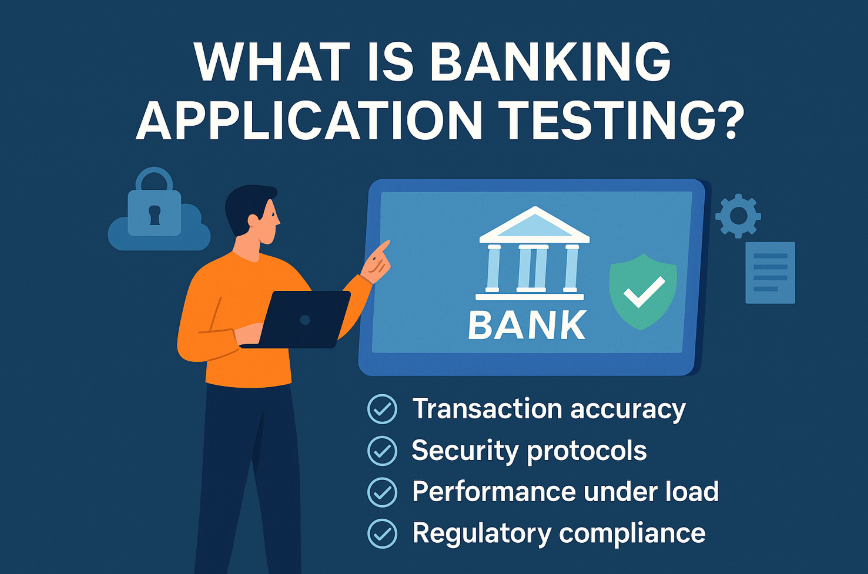
Banking application testing is the process of checking that financial apps work correctly, stay secure, perform well under load, and meet strict regulations. Unlike regular apps, banking software has zero room for errors. Transactions must be precise, security airtight, and compliance always in place.
Unlike general app testing, it must validate:
- Transactions post correctly: No duplicates, no mismatched ledgers
- Security holds up: Encryption, OTPs, fraud checks, access controls
- Systems scale: Apps stay fast even when traffic spikes on payday
- Regulations are met: PCI DSS, GDPR, PSD2, and whatever else applies
Today’s banking apps don’t live in isolation. They plug into payment rails, credit bureaus, fraud engines, and a dozen third-party services. Testing has to cover the full chain, not just the UI to make sure every integration behaves the same in production as it did in staging.
That’s where DevAssure O2 comes in: an autonomous testing agent on every pull request that reads the diff, maps impact on payment and account flows, generates scoped tests, and reports back — without maintaining a Selenium library for every compliance-driven UI change.
The full DevAssure platform adds Yaan AI, test data management, and omnichannel suites when you need more than PR-native validation.
🚀 See how DevAssure accelerates test automation, improves coverage, and reduces QA effort.
Ready to transform your testing process?
Core Components of Banking Application Testing
- Functional Testing: Covers everyday banking flows—opening accounts, moving funds, processing loans, paying bills. Even tiny errors matter here. A rounding glitch of a few cents, scaled across millions of transactions, can throw off entire ledgers.
- Security Testing: Focuses on keeping data and money safe. This means checking encryption, login and OTP flows, and running penetration tests to spot vulnerabilities early. Standards like PCI DSS set the baseline, but real resilience comes from testing as if attackers are already knocking.
- Performance Testing: Makes sure the app doesn’t choke when traffic spikes. Think salary day logins, tax filing season, or sudden market swings. The expectation: sub-second responses, even when thousands of users hit the system at once.
- Compliance Testing: Validates that the app meets regulations such as AML, KYC, GDPR, SOX, and local banking laws. Falling short here doesn’t just risk bugs—it can mean heavy fines, audits, and restrictions on operations.
Why Banking Application Testing Matters in 2025
For most people, the banking app is the bank. If it fails whether during a balance check or a payment- trust takes a hit, and users move on.
Cybersecurity Is Relentless
Banks are prime targets for attackers. The average breach in financial services hit $6.08M in 2024 (IBM). One weak API call, misconfigured auth flow, or unpatched service can open the door to fraud.
Compliance Keeps Tightening
By March 2025, PCI DSS 4.0 becomes mandatory. Add PSD2, GDPR, AML, and local laws, and you’ve got a moving target of requirements that demand constant validation.
Customers Don’t Wait
Nobody tolerates a delayed transfer or failed OTP. Users expect instant responses, 24/7 uptime, and seamless experiences. A single bad session is enough for someone to try another bank.
AI Raises the Stakes
Fraud checks, credit scoring, even chatbots now depend on AI. If models drift or signals misfire, the fallout hits customer trust and regulators notice fast.
No Margin for Error
Think salary-day surges, IPO allotments, or tax deadlines. Without proper testing, those peak loads can crash systems, cause failed transactions, and trigger compliance penalties.
Related Reading: Read how AI agents are transforming test automation in 2025.
How Does Banking Application Testing Work?
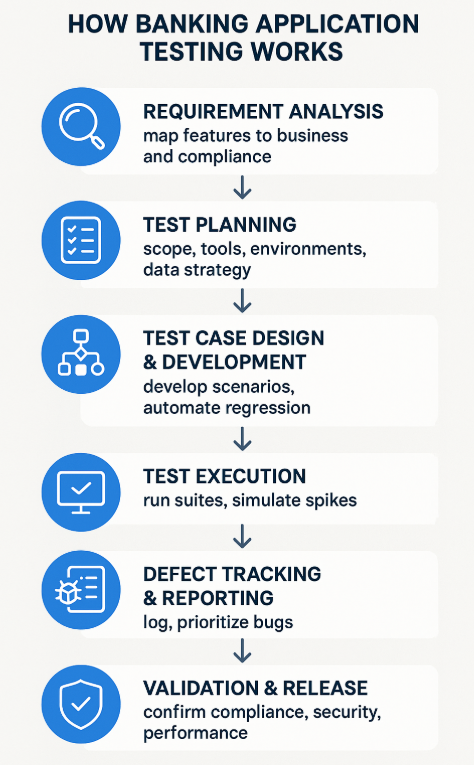
Banking application testing is a workflow that mirrors how money actually moves through the system. Here’s what it usually looks like:
- Requirement Analysis
Teams map every feature against business rules and compliance needs. For example, a “fund transfer” flow must align with KYC/AML checks and transaction limits.
- Test Planning
Scope, tools, environments, and data strategy are defined here. In banking, synthetic data or masked production data is often used to stay compliant while keeping tests realistic.
- Test Case Design & Development
Scenarios cover login flows, transfers, loan approvals, and integration points like payment gateways. Automation usually takes over repetitive regression paths, while edge cases stay manual.
With DevAssure’s AI test generation, teams can auto-generate banking-specific test cases based on business rules, reducing manual effort and boosting coverage across login, payments, and fraud detection flows.
- Test Execution
Test suites are run across devices, browsers, and environments. Load and stress tests simulate real-world spikes — think payday surges or market volatility.
- Defect Tracking & Reporting
Bugs are logged, prioritized, and tracked in dashboards. Critical ones (like double debits or failed settlements) get escalated immediately.
- Validation & Release
Final runs confirm compliance (PCI DSS, GDPR, PSD2), security posture, and performance benchmarks. Only then does the build move to production.
Key Benefits of Banking Application Testing
- Security you can trust: Bugs in auth flows or broken encryption aren’t “just bugs.” In banking, they’re open doors for fraud. Testing closes those doors before someone else walks in.
- Staying compliant: With PCI DSS 4.0 and other regulations rolling in, banks can’t afford to miss checks. Good testing means fewer audit surprises and no last-minute scrambles.
- Surviving peak traffic: Payday, tax season, IPOs—traffic floods in. If the app slows down, users bail. Performance testing proves the system can take the hit and still respond fast.
- Shipping without fear: Automated test suites let teams release faster and with more confidence. It’s the difference between deploying at 5 p.m. on Friday or losing your weekend to bug fixes.
- Earning user trust: Nobody forgets a failed transfer. A reliable app keeps customers from jumping ship and turns everyday use into long-term loyalty.
- Beating the competition: Plenty of banks offer the same features. The one that works smoothly with no glitches, no downtime wins. Testing is how you get there.
Challenges in Banking Application Testing
-
Sensitive data everywhere: You can’t just spin up fake accounts and call it a day. Test data has to feel real enough to catch bugs, but still stay compliant with privacy rules like GDPR and AML.
-
Complex integrations: Banking apps don’t live alone. They talk to payment rails, credit bureaus, fraud engines, and third-party fintech APIs. One change upstream can break everything downstream.
DevAssure O2 validates API and UI impact from each PR; the full platform integrates with core banking APIs and third-party fintech services for long-lived suites.
-
Device and platform chaos: Your app has to work on an iPhone 15, a budget Android, and every browser in between. Testing across that matrix is messy and time-consuming. Here’s how DevAssure handles simplifies mobile app testing for complex use cases.
-
Constantly moving regulations: Just when you’ve built a compliant flow, new rules land—PCI DSS 4.0, PSD2 updates, RBI guidelines. Teams have to retest and revalidate faster than their release cycles.
-
Handling massive load spikes: Think payday, tax filing season, or market volatility. The system must stay rock solid under traffic bursts that don’t look anything like staging.
-
Zero tolerance for failure: A minor bug in a social app is an annoyance. In banking, it’s lost money, angry customers, and maybe a headline in tomorrow’s paper.
Related Reading: Why flexible mobile testing is critical in regulated apps
Essential Tools and Best Practices for 2025
Here’s a quick look at the tools most teams rely on in 2025:
| Category | Popular Tools | What They’re Used For |
|---|---|---|
| Automation | Selenium, Appium, Playwright | Automating core banking flows like logins, transfers, and regression suites |
| Performance/Load | JMeter, Gatling, k6 | Stress-testing apps under peak events (salary day, tax season, IPO spikes) |
| Security | OWASP ZAP, Burp Suite, Nessus | Validating encryption, auth flows, and spotting API vulnerabilities |
| Compliance/Audit | SonarQube, Veracode, Checkmarx | Ensuring code and workflows align with PCI DSS, PSD2, GDPR, etc. |
| Autonomous PR agent | DevAssure O2 | Diff-scoped test generation and execution; no script suite to maintain |
Read More: Learn the difference between manual and automation testing.
What Are the Best Practices for Banking Application Testing?
Tools alone don’t guarantee quality—how you test matters just as much. These best practices help banking apps stay secure, compliant, and reliable in 2025.
- Shift Left, Test Early: Don’t wait until staging to catch issues. Pull testing into CI/CD pipelines so bugs are flagged while code is still fresh.
- Automate the Right Stuff: Automate regression-heavy paths like fund transfers or login flows. Save manual testing for risky edge cases that automation often misses.
- Use Realistic Test Data: Synthetic or masked production data keeps tests accurate without exposing sensitive PII. Unrealistic data equals misleading results.
- Keep Environments Close to Prod: Performance in staging doesn’t mean much if prod is architected differently. Align environments so load tests reflect real-world behavior.
- Validate Security Continuously: Run pen tests, API scans, and vulnerability checks as part of regular builds. A single untested endpoint can open the door to attackers.
- Monitor Regulatory Shifts: Rules don’t stand still. PCI DSS 4.0, AML, PSD2 updates—every change needs a test pass. Build compliance checks into release cycles.
- Foster Dev–QA–Compliance Collaboration: Testing works best when it’s not siloed. Developers, testers, and compliance officers should share responsibility instead of tossing builds over the wall.
Also read: A complete guide to fintech application testing in 2025
Building Future-Ready Banking Apps
In 2025, banking application testing is all about risk management. The focus has shifted from fixing bugs late to building resilience from day one.
The winners will be teams that combine financial domain knowledge with modern testing: automation at scale, AI-driven orchestration, continuous security checks, and compliance baked into every release.
Performance under pressure remains the true benchmark. Salary-day surges, cyberattacks, or new compliance rules—apps need to handle it all without breaking trust.
This is where DevAssure O2 makes a difference: autonomous validation on every PR so BFSI teams ship faster without growing another brittle automation estate. Start on GitHub.
🚀 See how DevAssure accelerates test automation, improves coverage, and reduces QA effort.
Ready to transform your testing process?
Frequently Asked Questions (FAQs)
To make sure the app does what it should—move money correctly, stay secure, hold up under load, and meet rules like PCI DSS or PSD2. If any of these fail, trust is gone.