Test Automation with AI Agents

Modern software delivery has fundamentally changed. What once followed a slow, linear release cycle: design → development → testing → release—has now evolved into a continuous, fast-moving pipeline powered by Agile, DevOps, and CI/CD practices. In this environment, traditional test automation is no longer enough.
Earlier, automation relied heavily on:
- Static scripts (Selenium, Cypress, etc.)
- Manual test case creation
- Frequent maintenance due to UI or logic changes
- Long regression cycles (often 30–60 minutes per build)
This approach created bottlenecks. QA teams were constantly firefighting flaky tests, updating selectors, and struggling to keep pace with development velocity.
Enter the AI Era in Test Automation
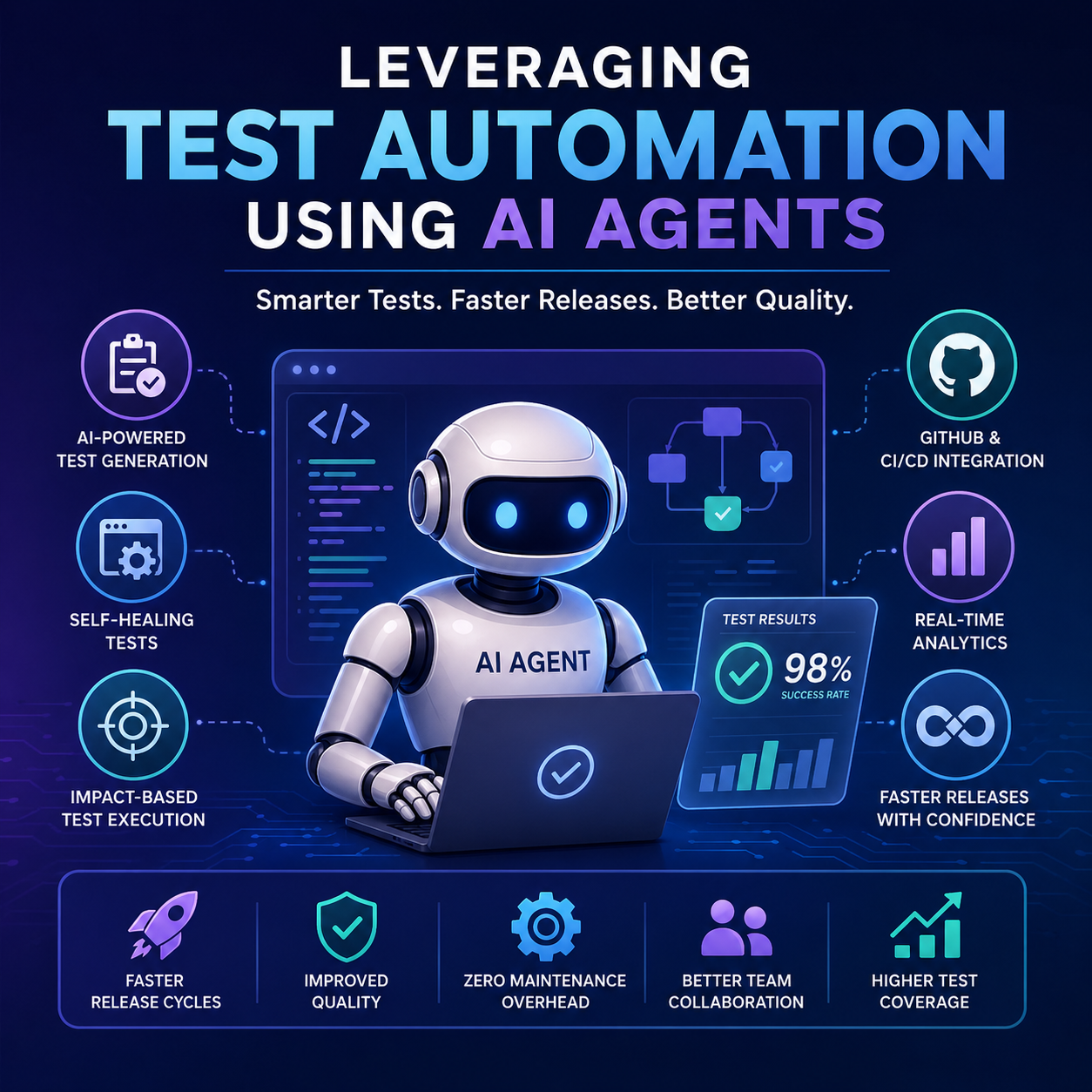
With the rise of Artificial Intelligence, test automation is undergoing a massive transformation. AI-powered systems are now capable of:
- Understanding application behavior
- Generating test cases automatically
- Adapting to UI and logic changes
- Executing targeted tests based on code changes
This shift introduces a new paradigm: AI Agentic Test Automation.
Instead of writing and maintaining scripts manually, QA Engineers and SDETs now collaborate with intelligent agents that:
- Reduce manual effort
- Shorten the Software Testing Life Cycle (STLC)
- Improve release confidence
- Enable faster and more reliable deployments
What is an AI Agent?
An AI Agent is an autonomous system that can perceive its environment, make decisions, and take actions to achieve specific goals.
In the context of software testing, an AI Agent:
- Observes application behavior (UI, API, workflows)
- Understands code changes and their impact
- Generates and executes relevant tests
- Learns from past executions to improve future outcomes
Unlike traditional automation tools, AI Agents are not just executors—they are decision-makers.
How AI Agents Help Software Testing Teams
AI Agents empower QA and SDET teams by:
- Eliminating repetitive manual work
- Reducing dependency on scripting knowledge
- Automatically maintaining test suites
- Improving test coverage without increasing effort
- Aligning testing directly with development changes
This allows teams to shift focus from test maintenance → quality strategy.
Types of AI Agents
AI Agents can be categorized based on their functionality and level of intelligence:
1. Reactive Agents
- Operate based on current input only
- Do not store past data
Example: Basic self-healing test scripts
2. Model-Based Agents
- Maintain an internal model of the environment
- Use historical data to make better decisions
Example: Tools that adapt to UI changes over time
3. Goal-Based Agents
- Work towards achieving specific objectives
Example: Generating test cases to validate a feature release
4. Utility-Based Agents
- Optimize decisions based on performance metrics
Example: Prioritizing test cases based on risk and impact
5. Learning Agents
- Continuously improve using feedback and data
Example: AI systems that reduce flaky tests over time
In modern QA environments, most AI testing platforms combine multiple agent types to deliver a hybrid intelligent system.
AI Agents in Software Testing
AI Agents are revolutionizing how testing is performed by introducing autonomy, intelligence, and adaptability.
Key Capabilities
AI Agents in software testing can:
- Automatically generate test cases from requirements, UI, or APIs
- Analyze code changes and identify affected areas
- Execute only relevant tests instead of full regression suites
- Self-heal broken tests due to UI or DOM changes
- Detect anomalies and potential defects proactively
Benefits of AI Agentic Testing
- Faster Release Cycles
AI reduces regression time drastically by running only impacted tests.
- Zero Maintenance Overhead
No need to constantly update scripts—agents adapt automatically.
- Improved Test Coverage
AI explores edge cases that humans might miss.
- Reduced Flakiness
Self-healing capabilities ensure stable test execution.
- Enhanced Developer Confidence
Developers can ship faster knowing critical paths are validated.
- Better Collaboration
Bridges the gap between QA, Dev, and Product teams.
Traditional Ways of Testing vs AI Agentic Approach
| Aspect | Traditional Testing | AI Agentic Testing |
|---|---|---|
| Test Creation | Manual scripting | Auto-generated by AI |
| Maintenance | High effort | Zero or minimal |
| Execution | Full regression runs | Targeted, impact-based |
| Speed | Slow | Fast and optimized |
| Adaptability | Breaks with changes | Self-healing |
| Coverage | Limited | Intelligent and expanding |
| Scalability | Difficult | Highly scalable |
Traditional automation is static and reactive, while AI Agentic testing is dynamic and proactive.
Omnichannel Capability
One of the biggest advantages of AI-driven test automation is its ability to integrate seamlessly across the entire development ecosystem.
GitHub Integration
AI Agents can:
- Pull code changes directly from repositories
- Analyze commits and identify impacted areas
- Automatically update test cases based on code changes
CI/CD Integration
Supports integration with tools like:
- Jenkins
- CircleCI
- GitHub Actions
- GitLab CI
This enables:
- Automated test execution on every build
- Continuous validation of code changes
- Faster feedback loops
Unified Test Lifecycle
AI-powered platforms bring everything into one place:
- Test Case Generation
- Test Maintenance
- Test Execution
- Reporting & Analytics
This eliminates tool fragmentation and creates a single source of truth for quality assurance.
About DevAssure
DevAssure is an AI-powered, no-code test automation platform designed to help teams build, execute, and maintain tests across Web, API, Mobile, Visual, and Accessibility testing all within a unified ecosystem.
It embraces the AI agentic approach to eliminate manual testing bottlenecks and accelerate software delivery.
DevAssure’s Approach to AI Testing
DevAssure leverages intelligent agents to:
- Understand application workflows
- Generate test cases automatically
- Maintain test suites without manual intervention
- Integrate deeply into CI/CD pipelines
- Provide real-time insights and analytics
Key Features of DevAssure
1. AI-Powered Test Generation
Create test cases from:
- PRDs
- UI screens
- APIs (Swagger)
- User workflows
2. No-Code Automation
Enables both technical and non-technical users to build tests effortlessly.
3. Self-Healing Tests
Automatically adapts to UI and DOM changes.
4. Omnichannel Testing
Supports:
- Web Testing
- API Testing
- Mobile Testing
- Visual Testing
- Accessibility Testing
5. CI/CD Integration
Seamless integration with modern DevOps pipelines.
6. Advanced Analytics
Provides actionable insights for better decision-making.
DevAssure O2 – The AI Testing Agent
DevAssure introduces O2, an intelligent AI testing agent designed to transform how teams approach testing.
What Makes O2 Different?
Unlike traditional automation tools, O2 works directly with your codebase and development workflow.
Key Capabilities of O2
1. Impact Mapping
O2 instantly traces code changes to affected user flows and components, ensuring complete validation coverage.
2. Dynamic Test Generation
Automatically generates and executes end-to-end test scenarios based on detected changes.
3. Zero-Maintenance Test Suites
No manual updates required—tests evolve automatically with your application.
4. From Push to Production
- Connect your repository
- O2 builds your testing pipeline
- Execute tests automatically
- Monitor and iterate seamlessly
5. Commit with Confidence
Run targeted test sessions directly within your workflow without leaving the editor.
6. Test Directly from Git Changes
O2 focuses on specific branches or commits, ensuring testing aligns with actual code changes.
How O2 Handles Code Changes Without Manual Effort
One of the standout capabilities of O2 is its ability to adapt to code changes automatically:
- Detects changes at the commit level
- Identifies impacted workflows
- Updates existing test cases intelligently
- Removes obsolete test paths
- Generates new test scenarios where needed
This ensures:
- No outdated tests
- No broken pipelines
- Continuous validation with zero manual effort
Conclusion
The future of software testing is no longer manual or script-heavy—it is intelligent, autonomous, and agent-driven.
AI Agents are redefining the way QA teams operate by:
- Eliminating repetitive work
- Reducing maintenance overhead
- Accelerating release cycles
- Improving software quality
Platforms like DevAssure are leading this transformation by introducing powerful AI agents like O2 that seamlessly integrate into modern development workflows.
As software systems grow more complex and release cycles become faster, adopting AI-driven test automation is no longer optional it is essential.
The shift is clear: from writing tests to orchestrating quality with AI Agents.
🚀 See how DevAssure accelerates test automation, improves coverage, and reduces QA effort.
Ready to transform your testing process?