Google I/O 2026 Went All-In on Agentic Coding. Here's What It Means for Testing.

TL;DR
Google I/O 2026 shifted from AI-assisted to agentic coding — Antigravity 2.0, Managed Agents, Gemini 3.5 Flash, and more. Generation got massive investment; validation did not. Engineering leaders need a quality layer that scales with agent output: independent testing on every PR, not more human review. That is what DevAssure O2 is built for.
Google I/O 2026 made one thing unmistakably clear: the era of AI-assisted coding is over. The era of AI-agentic coding has begun.
The keynote opened with a line I have been thinking about since:
"We've transitioned from AI that simply assists you, to agents that can independently navigate complex tasks across your entire workflow."
What followed was a two-hour parade of agent-first announcements: Antigravity 2.0, the Antigravity CLI and SDK, Managed Agents in the Gemini API, Gemini 3.5 Flash, WebMCP, Chrome DevTools for agents, an Android migration agent that converts entire React Native apps to Kotlin, and vibe-coding Android apps directly in Google AI Studio.
Most commentary since has focused on productivity. How fast can you ship? How many agents can you orchestrate in parallel? How much code can Gemini 3.5 Flash produce per minute?
I want to focus on a different question — one Google did not spend much time on during the keynote:
Who tests what the agents produce?
I run a company that builds autonomous testing agents, so I have an obvious bias. I also have data, and the data is worth examining.
What Google actually announced (the parts that matter for quality)
Let me break down the I/O announcements through the lens of engineering quality and reliability.
Antigravity 2.0: From coding assistant to agent orchestrator
Antigravity is no longer just an IDE. It is a five-surface platform: a desktop app, a CLI, an SDK, a Managed Agents API, and an enterprise deployment path.
The most significant capability is dynamic subagents running in parallel. You can spin up multiple specialized agents — one building the frontend, one writing the API, one configuring infrastructure — all executing simultaneously within a single workflow.
You can also schedule tasks to run in the background. That converts the agent from a single-turn tool into something closer to a persistent automation pipeline.
For engineering leaders, the implication is straightforward: your team's code output is about to increase dramatically. A single developer orchestrating three parallel subagents produces the equivalent volume of a small team. Gemini 3.5 Flash was built for this — reportedly 4× faster than other frontier models in output tokens per second, co-developed using Antigravity itself.
The quality question
If one developer now generates the output of three, are your testing and review processes designed for 3× the code volume? For most teams, the answer is no. Code review, test suites, and QA were calibrated for human-speed development. They are about to hit a bottleneck.
Managed Agents: Agentic coding as an API call
Managed Agents in the Gemini API is arguably the most consequential announcement for how production software gets built. A single API call provisions a fully sandboxed agent that can write, execute, and iterate on code.
Agentic coding is no longer confined to developer machines. It is available as infrastructure. Any CI/CD pipeline, internal tool, or workflow engine can invoke an agent to modify code programmatically.
The quality question
When agents write code inside automated pipelines — with no human at the point of generation — what validates the output before production? The traditional answer was "the developer reviews it." If the agent is invoked by a pipeline, not a person, who is reviewing?
WebMCP and Chrome DevTools for agents
WebMCP is a proposed open standard that lets browser-based AI agents execute tasks by interacting with structured tools (JavaScript functions, HTML forms) exposed by web developers.
Chrome DevTools for agents brings debugging and quality auditing to AI agents — letting them verify, debug, and optimize code without manual oversight.
The quality question
Google is thinking about quality here. Chrome DevTools for agents can automate Lighthouse audits and emulate user experiences. But it focuses on web performance and standards — not functional correctness, regression detection, or business-logic bugs that cause production incidents.
Android migration agent
Google previewed an Android Studio feature that migrates entire apps from React Native, web frameworks, or iOS to native Kotlin. The agent analyzes source code and converts it — weeks of manual work into hours.
The quality question
A migration agent producing thousands of lines of Kotlin is impressive — and a massive surface for subtle behavioral differences. The app may compile and pass smoke tests while handling edge cases, offline behavior, accessibility, and platform conventions differently from the original. Preserving behavioral contract is a testing problem, not a generation problem.
The pattern across all of these announcements
Step back from I/O 2026 and a clear pattern emerges:
| Announcement | What it accelerates | What it assumes about quality |
|---|---|---|
| Antigravity 2.0 parallel subagents | Code generation volume | Developers review agent output |
| Managed Agents API | Programmatic code generation | Callers validate results |
| Gemini 3.5 Flash (4× speed) | Output velocity | Faster is better |
| Android migration agent | Large-scale code transformation | Migration preserves behavior |
| WebMCP | Agent-driven browser interaction | Tools are correctly implemented |
| AI Studio → vibe-code Android apps | App creation speed | Generated apps work correctly |
The generation side is receiving massive investment. The validation side gets Chrome DevTools for agents (web performance) and Android Bench (an LLM leaderboard). Both are useful. Neither fully answers:
Does the generated code work correctly in the context of your specific system?
Why this matters for engineering leaders now
If you lead an engineering team, I/O 2026 is a signal to start thinking about three things:
1. Your review process will become the bottleneck
Antigravity's parallel subagents and Managed Agents mean more PRs, more changed files, more touched components — than your current review process can handle.
The math is simple:
Code review does not scale linearly with code volume. It degrades. Reviewer fatigue is well-documented — and as volume increases, missed issues compound.
See The Vibe Coding Quality Gap for how this plays out on fast-moving AI PRs.
2. Static test suites will not keep up
Your existing test suite was written for your codebase as it existed weeks or months ago. When an agent generates a new module, migrates a framework, or refactors a service — existing tests may still pass while behavior has fundamentally changed.
Static suites validate what you tested before. They do not adapt to what changed today.
In the agentic era, testing needs to be dynamic — generated from the actual code change, aware of the dependency graph, and targeted at components affected by each PR. That is ephemeral, PR-native testing.
3. Separation of concerns applies to agents too
Google framed the future as agents that independently navigate complex tasks across your workflow.
I would add a nuance: the agent that writes code should not be the same agent that tests it.
This is not a technical limitation. It is a design principle. Fresh eyes, different assumptions, adversarial thinking — the same reasons code review works for humans.
A generation agent optimizes for producing code that appears correct. A testing agent optimizes for finding conditions under which code fails. Combining them recreates the blind-spot problem of coding agents testing their own output.
Generation agent (Antigravity, Cursor, Copilot)
    → writes the code

Testing agent (DevAssure O2)
    → validates the code independently

Human (engineering leader, developer)
    → merge or not
Where DevAssure fits in the post-I/O landscape
We built DevAssure for this moment.
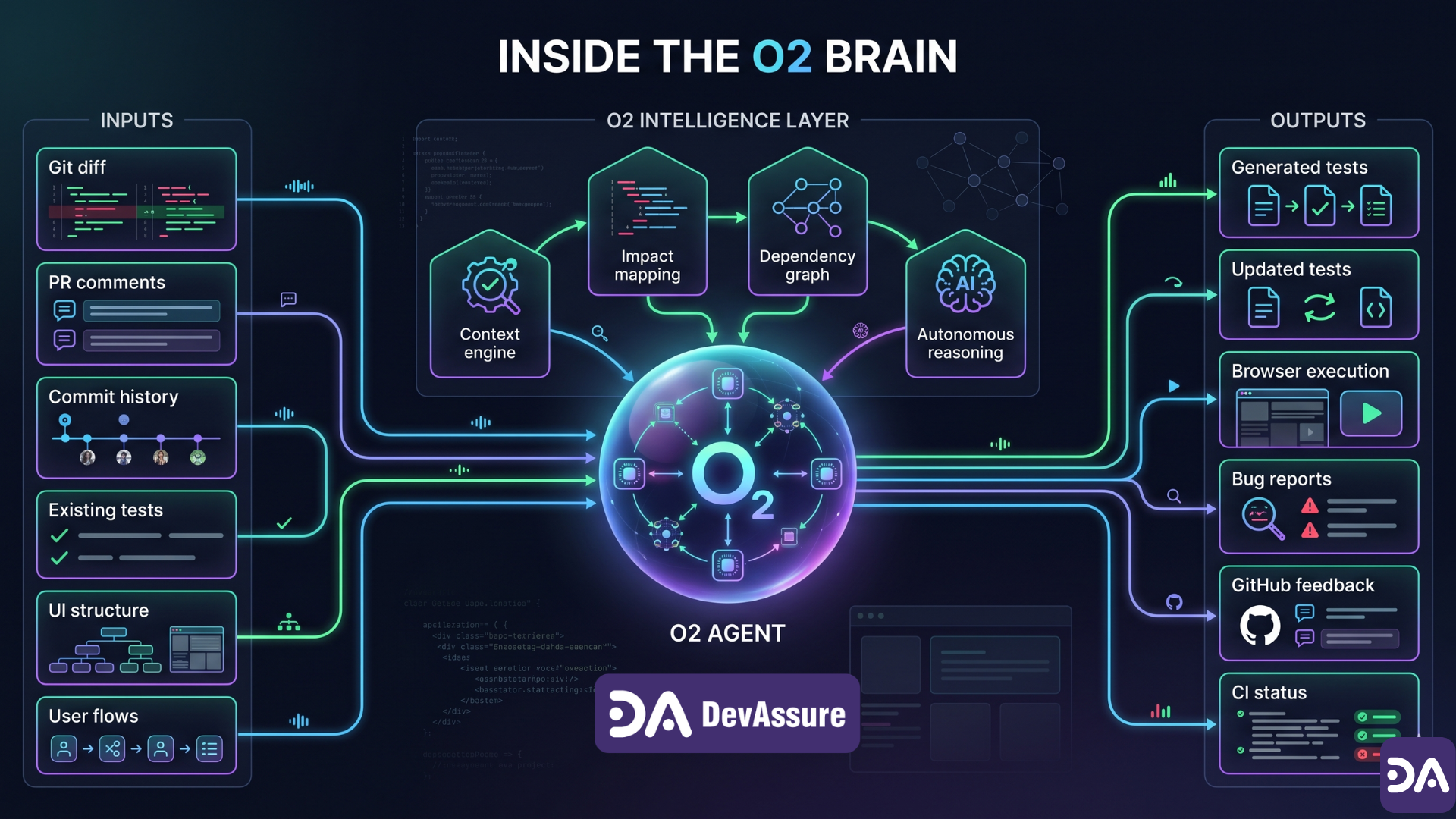
O2 Agent is a testing-specific agent that integrates into CI/CD via GitHub Actions. When a PR opens — whether the code was written by a human, Cursor, Copilot, or an Antigravity subagent — O2:
- Reads the diff with zero prior assumptions
- Traces the dependency graph for blast radius
- Checks git history for historically fragile components
- Generates regression and feature tests specific to the change
- Executes them and posts results as a PR comment
The key property: O2 has never seen the code before. It has no model of what the code should do. It reads what changed and asks what could break.
Different systems. Different objectives. The human retains judgment. The mechanics are automated.
steps:
  - uses: devassure-ai/devassure-action@v1
What I recommend to engineering leaders right now
If you are evaluating Antigravity 2.0, Gemini 3.5, Managed Agents, or alternatives — here is a practical framework:
For implementation details, see How to Set Up Vibe Testing on Every Pull Request and Shift Left Failed — Autonomous Testing Is What Comes Next.
Frequently asked questions
Key launches included Antigravity 2.0 (parallel subagents, CLI, SDK, enterprise path), Managed Agents in the Gemini API, Gemini 3.5 Flash, WebMCP, Chrome DevTools for agents, an Android migration agent, and vibe-coding Android apps in Google AI Studio. The through-line was agents that execute full workflows, not just assist.
The bottom line
Google I/O 2026 is the clearest signal yet that agentic coding is becoming the default mode of software development. The tools are powerful, the investment is massive, and the productivity implications are transformative.
But the keynote's conspicuous gap was quality. In a world where agents write code at 4× speed, in parallel, and as API calls — who validates that code before it reaches users is not a detail. It is the central challenge of the agentic era.
The companies that thrive are not the ones that adopt agentic coding fastest. They are the ones that adopt it with a quality framework that matches the speed.
Speed is the default now. Everyone gets Antigravity 2.0. Everyone gets Gemini 3.5 Flash. The differentiator is confidence — shipping fast and knowing it works.
That is the problem we are solving at DevAssure. After I/O 2026, it has never been more relevant.
- GitHub Action: Marketplace listing
- Sign up: app.devassure.io/sign_up
- Engineering leaders: divya@devassure.io
$50 in free credits for 30 days. One YAML line. Every PR tested autonomously.
Links
- Vibe coding quality gap: https://www.devassure.io/blog/vibe-coding-quality-gap/
- Why coding agents can't test: https://www.devassure.io/blog/why-coding-agents-cant-test/
- Shift left failed — autonomous testing: https://www.devassure.io/blog/shift-left-failed-autonomous-testing/
- Test automation with AI agents: https://www.devassure.io/blog/test-automation-with-ai-agents/
- GitHub Actions guide: https://www.devassure.io/blog/github-actions/
- DevAssure O2: https://www.devassure.io/o2-testing-agent
- DevAssure: https://www.devassure.io