The Vibe Coding Quality Gap: Why AI-Generated Code Needs a Testing Agent, Not More Tests

TL;DR
Vibe coding ships features in minutes - but AI-generated code has 1.7× more production issues than hand-written code, and asking the same AI to write tests repeats the same blind spots. The fix is not more tests; it is an independent testing agent that reads each PR cold. DevAssure O2 validates vibe-coded diffs at PR speed with zero scripts to maintain.
Last week I watched a developer build an entire payment integration in 35 minutes using Cursor.
User authentication. Stripe checkout. Webhook handling. Invoice generation. All wired up and functional.
In 2023, that is a week-long sprint. In 2026, it is a Tuesday morning before standup.
Then we ran DevAssure's O2 Agent on the PR.
Focus on the merge gate? Read the companion: Why your vibe-coded PR keeps breaking production — the handoff from coding agent to CI, not the quality-gap theory.
O2 found 5 issues:
None of these are "wrong code." The functions work. The happy path is perfect. Demo it to a stakeholder and it looks flawless.
Every one of them would cause a production incident within the first week under real traffic.
This is the vibe coding quality gap.
What the data says
The phrase vibe coding was coined by Andrej Karpathy and has become the dominant paradigm for a significant portion of developers. You describe what you want, the AI builds it, you iterate via conversation.
The productivity gains are undeniable. The quality data is concerning:
The genie is not going back in the bottle - nor should it. The productivity gains are real.
The question is: how do we capture the speed without inheriting the risk?
For the concept behind testing at the same speed as vibe coding, see What is Vibe Testing.
Why traditional testing does not work for vibe-coded apps
Problem 1: The code arrives faster than humans can review it
A developer vibe-coding with Cursor can produce 5–10 PRs per day. Each PR might touch 20–50 files. Reviewers cannot carefully read every line. They pattern-match. They skim. They look for obvious red flags and move on.
This is not laziness. It is physics. Humans process code at a fixed rate. When volume increases 5×, something has to give - and that something is review thoroughness.
Problem 2: AI-written tests validate AI assumptions
The most common workflow in 2026:
The problem is structural. The same model that made assumption X while writing the code will make assumption X again while writing the tests. The tests validate the assumption instead of challenging it.
Here is a concrete example:
# AI-generated code: validates email format
def validate_email(email):
    pattern = r'^[a-zA-Z0-9._%+-]+@[a-zA-Z0-9.-]+\.[a-zA-Z]{2,}$'
    return bool(re.match(pattern, email))

# AI-generated test: confirms the regex works
def test_validate_email():
    assert validate_email("user@example.com") == True
    assert validate_email("invalid") == False
    assert validate_email("user@domain.co.uk") == True
Looks great. Tests pass. But what about:
user@example.com<script>alert(1)</script>- angle brackets after the TLD- An email with 1,000 characters - no length check, potential ReDoS
- Unicode domain names - regex handles ASCII only
- Empty string - what does the caller do with
NonevsFalse?
The AI tested what it built. It did not test what could go wrong.
See Why Your Coding Agent Can't Be Your Testing Agent for the full structural argument.
Problem 3: No test suite to fall back on
When a team vibe-codes a feature, there is often no pre-existing test suite for that area. The code is new. The tests are new. Everything was generated in the same session.
Traditional QA assumes a regression suite - tests that validate known behavior accumulated over months of human-paced development.
Vibe-coded features arrive fully formed. There is no accumulation period. There is no regression baseline.
What autonomous testing does differently
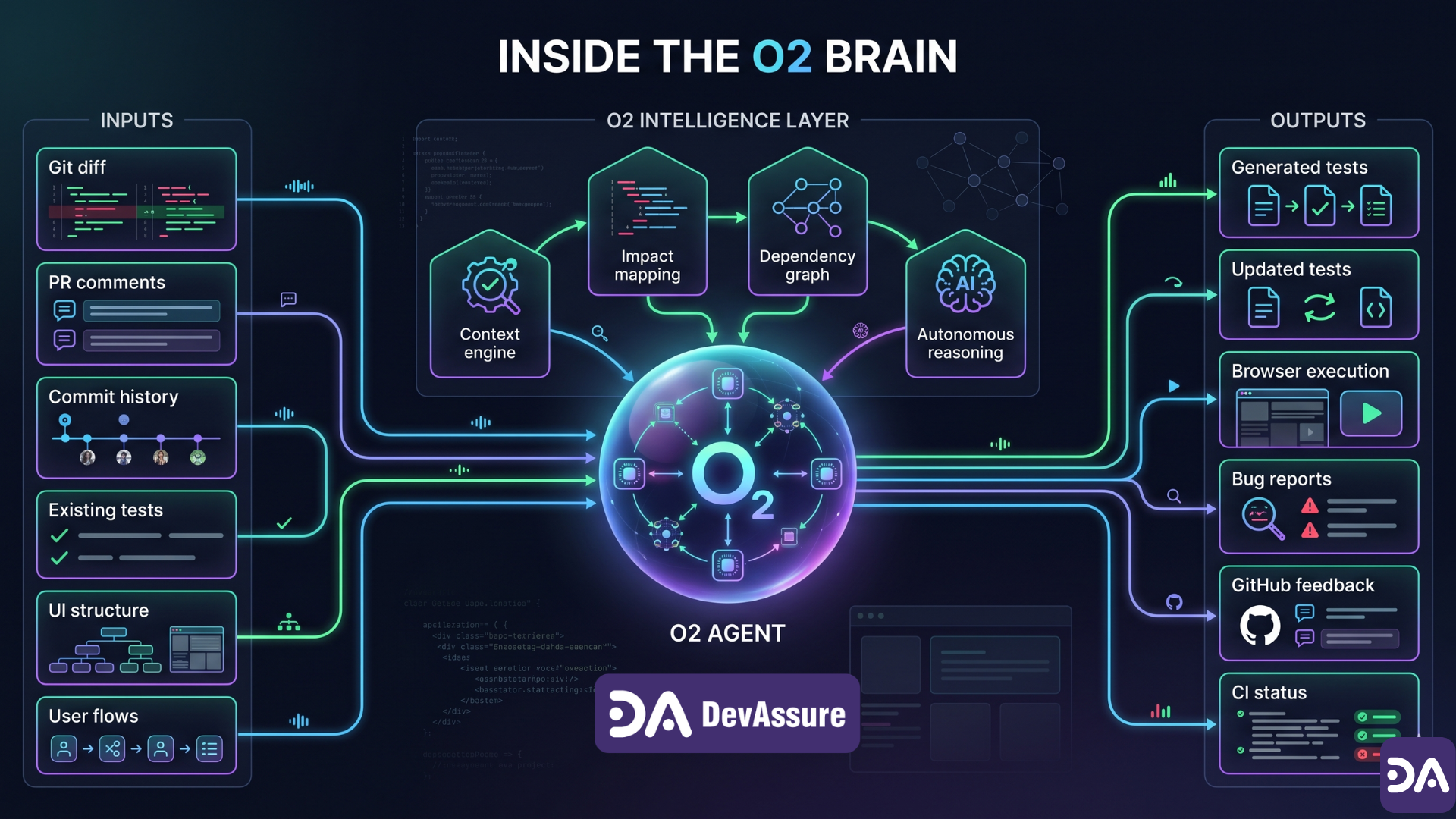
DevAssure's O2 Agent approaches vibe-coded PRs the same way it approaches any PR - by treating the code as something it has never seen before, with zero assumptions about intent.
Vibe coding makes certain O2 capabilities especially valuable:
Independent reasoning about correctness
O2 does not know what the developer intended. It reads the diff, infers the behavioral contract from the code, and asks: Under what conditions would this contract break?
That is fundamentally different from asking the same AI that wrote the code to evaluate it. O2's test generation is adversarial by design - it looks for failures, not confirmation.
System-level impact mapping
When a developer vibe-codes a payment module, they focus on the payment module - not the seven other components that interact with it.
O2 traces the dependency graph automatically:
Payment module changed
├── Checkout flow → test order creation with new payment logic
├── Webhook handler → test async processing of payment events
├── Invoice service → test invoice generation with new data shapes
├── Email service → test payment confirmation emails
├── Admin dashboard → test payment reporting with new fields
├── Refund flow → test refund against new payment structure
└── Analytics → test event tracking for new payment types
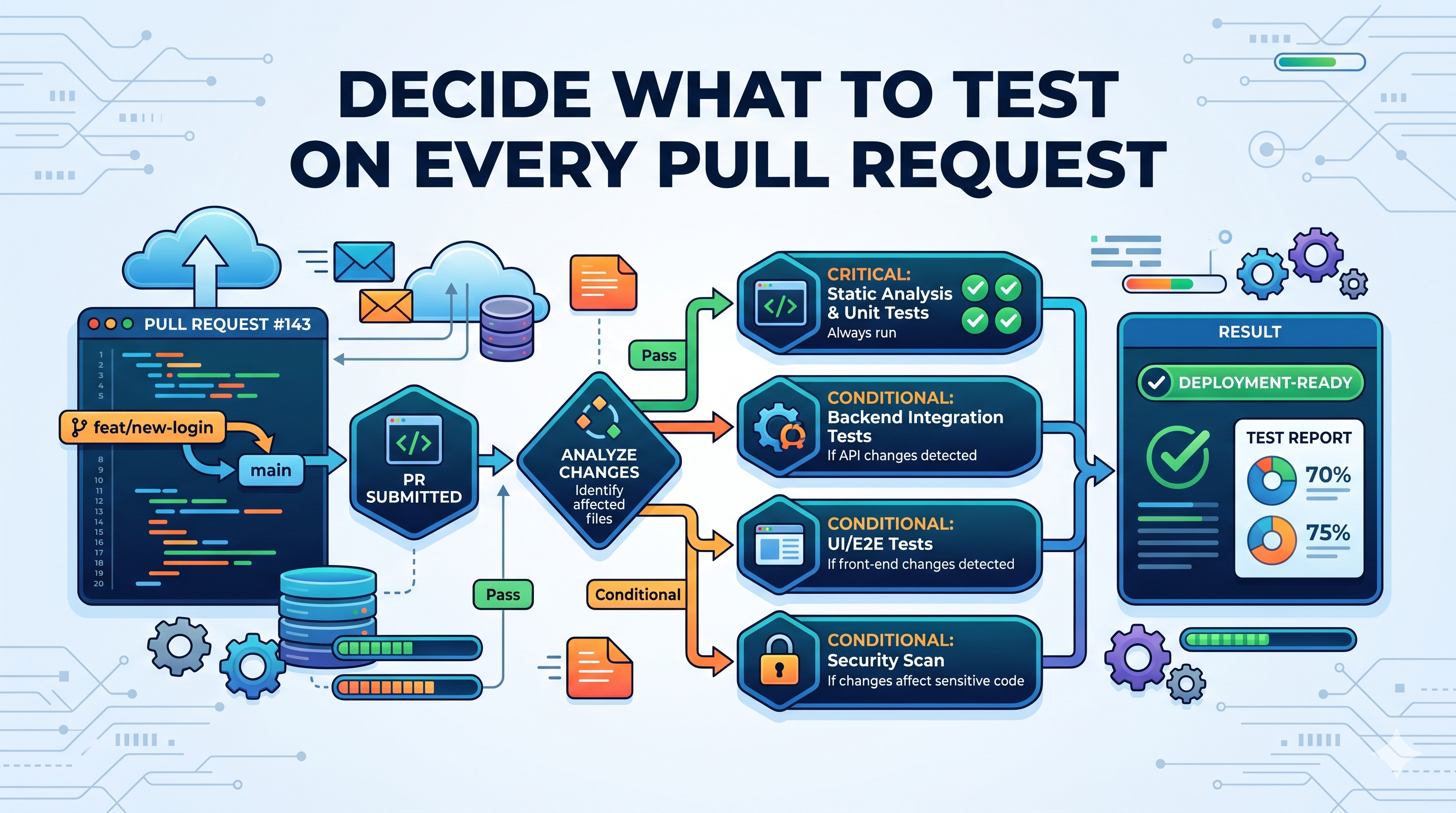
A human moving fast with AI might catch 2–3 of these. O2 traces what is connected, not what feels important in the moment.
Fresh eyes on every PR
The single most valuable property for vibe-coded apps: the agent has no memory of the development session.
When you spend 35 minutes in Cursor on a payment module, you and the AI share a mental model. You have seen every iteration. You know which edge cases you discussed.
O2 arrives after all of that, reads the final diff, and evaluates it cold. No conversation history. No shared assumptions. Just: These files changed. These are the implications. Here is what could break.
That fresh perspective is exactly what vibe-coded PRs need - and exactly what the developer who wrote them cannot provide.
A practical workflow for vibe coding with quality
Here is the workflow I recommend for teams vibe coding heavily:
# .github/workflows/ci.yml
name: CI
on: [pull_request]
jobs:
test:
  runs-on: ubuntu-latest
  steps:
- uses: devassure-ai/devassure-action@v1For step-by-step CI setup, see How to Set Up Vibe Testing on Every Pull Request.
The meta-point
Vibe coding is a genuine paradigm shift in how software gets built. Fighting it would be like fighting autocomplete in 2010 - pointless and counterproductive.
But every paradigm shift in creation demands a corresponding shift in validation.
| Era | Creation shift | Validation layer |
|---|---|---|
| Compiled languages | Handwritten → compiled | Compiler warnings |
| Microservices | Monolith → distributed | Distributed tracing |
| CI/CD | Manual deploy → automated | Pipeline gates |
| Vibe coding | Conversation → full features | Independent testing agent |
Vibe coding needs its validation layer. Not more tests. Not slower development. An intelligent, independent agent that validates what the AI produces - at the speed the AI produces it.
That is what we built. That is what O2 is.
Frequently asked questions
Vibe coding (building via AI conversation) produces working happy-path code fast, but often misses security, idempotency, race conditions, and compliance issues that only surface under real traffic. The gap is speed of creation without a matching validation layer.
The bottom line
The vibe coding quality gap is not a reason to slow down. It is a reason to stop validating AI code the way you validated human code - and to add an agent that tests every PR with fresh eyes.
Vibe code fast. Validate with O2.
- GitHub Action: Marketplace listing
- Free credits: app.devassure.io/sign_up
- Questions: support@devassure.io
$50 in free credits for 30 days. Two-minute setup.
Links
- What is Vibe Testing: https://www.devassure.io/blog/vibe-testing/
- How to set up vibe testing on every PR: https://www.devassure.io/blog/how-to-set-up-vibe-testing-on-every-pull-request/
- How to test Cursor-generated code: https://www.devassure.io/blog/how-to-test-cursor-generated-code/
- Why coding agents can't test: https://www.devassure.io/blog/why-coding-agents-cant-test/
- Shift left failed - autonomous testing: https://www.devassure.io/blog/shift-left-failed-autonomous-testing/
- The quiet death of the test script: https://www.devassure.io/blog/quiet-death-of-the-test-script/
- DevAssure O2: https://www.devassure.io/o2-testing-agent
- DevAssure: https://www.devassure.io