Shift Left Failed. Autonomous Testing Is What Comes Next.

TL;DR
For a decade, shift left meant developers write more tests earlier. That overloaded engineers, bloated suites, and barely moved the bug needle. Autonomous testing keeps the timing - tests at the pull request - but changes the mechanism: an agent reads the diff, generates scoped tests, runs them, and leaves nothing to maintain. DevAssure calls this shift smart: AI handles execution; humans handle judgment.
For a decade, the testing industry rallied behind a simple mantra: shift left.
Find bugs earlier. Test sooner. Put quality in the hands of developers.
The theory was sound. A bug caught in development costs roughly 10× less than one found in production. Move testing to the left of the timeline, and you save money, ship faster, and improve quality.
But here is what actually happened:
Shift left did not fail because the principle was wrong. It failed because the execution was wrong. We asked the right question Can we find bugs earlier? - and gave the wrong answer Yes, if developers write more tests.
What went wrong with shift left
1. We overloaded developers
Before shift left
After shift left
1
Build features- QA execution load (same developer)
10
Participate in code reviewSame role. Three responsibilities → ten. We did not give them better tools — we gave them more responsibilities.
Cisco's internal engineering blog documented this as shift-left exhaustion - the psychological and practical toll of adding continuous testing pressure on top of feature development. The added pressure of early and continuous testing, combined with faster cycle demands, led to measurable burnout.
2. Coverage became a vanity metric
The shift-left era introduced a dangerous equation: more tests = better quality.
Teams chased coverage numbers. 70%. 80%. 90%. Some mandated 100% coverage as a merge requirement.
But coverage measures quantity, not quality. You can have 95% line coverage and still ship a critical regression. Coverage tells you which lines were executed, not which behaviors were validated.
The majority of production bugs come from interactions between components - timing issues, race conditions, unexpected state combinations, downstream dependency failures. Unit tests, by design, isolate components. They cannot catch interaction bugs.
So we built massive test suites that made everyone feel safe - without actually being safe.
3. Test maintenance became the hidden tax
Every test you write is code that needs to be maintained. And unlike product code, test code does not generate revenue.
A typical mid-size SaaS application has 2,000-10,000 test cases. When the UI changes, dozens of E2E tests break. When an API contract changes, dozens of integration tests break. When a database schema migrates, everything breaks.
Our data from early DevAssure customers shows that QA teams spent 30-40% of their time maintaining existing tests - not writing new ones, not doing exploratory testing, not improving quality strategy. Just keeping the lights on.
That is not a testing strategy. That is a maintenance treadmill.
4. Flaky tests killed the safety net
Flaky tests are the silent killer of CI/CD confidence.
When a test fails randomly - network timeout, race condition in the test itself, environment inconsistency - and then passes on retry, it trains developers to do one thing: ignore red builds.
Once your team learns to ignore red builds, you have lost the safety net entirely. The pipeline still runs. The tests still execute. But nobody trusts the results. They merge anyway and hope for the best.
This is what shift left looked like in practice at many organizations. Not a culture of quality. A culture of noise.
What needs to change
The problem with shift left was not when testing happened. It was how.
Shift left assumed that humans would do the testing - just earlier. But the fundamental constraints of human testing did not change:
- Humans write tests based on what they know can break, not what might break
- Humans cannot rewrite the test suite every time the codebase evolves
- Humans get tired, skip edge cases, and rubber-stamp code reviews after the fiftieth line
- Humans cannot process a dependency graph of 200 components and reason about cascading failures
The next paradigm is not about when you test. It is about who tests - or more precisely, what tests.
Autonomous testing: the next paradigm
Autonomous testing removes humans from the test execution loop entirely.
Not from quality decisions. Not from strategy. From the mechanics of figuring out what to test, writing the tests, running them, and reporting results.
Here is what autonomous testing looks like in practice:
At the point of change
When a developer opens a pull request, the autonomous agent activates. Not at the end of a sprint. Not when QA has capacity. At the moment the code change exists.
Context-aware, not static
The agent reads the actual PR diff. It does not run a pre-existing suite. It generates tests specific to this change:
Change analysis: What logically changed in this PR? Not just which files were touched - what behavioral modifications were made?
History context: Has this area of code been fragile before? How recently? How many times? Components with a history of bugs get deeper testing.
Impact mapping: What downstream components depend on what changed? If the authentication module was modified, the agent traces that to payment processing, session management, API authorization, and any other component that touches auth.
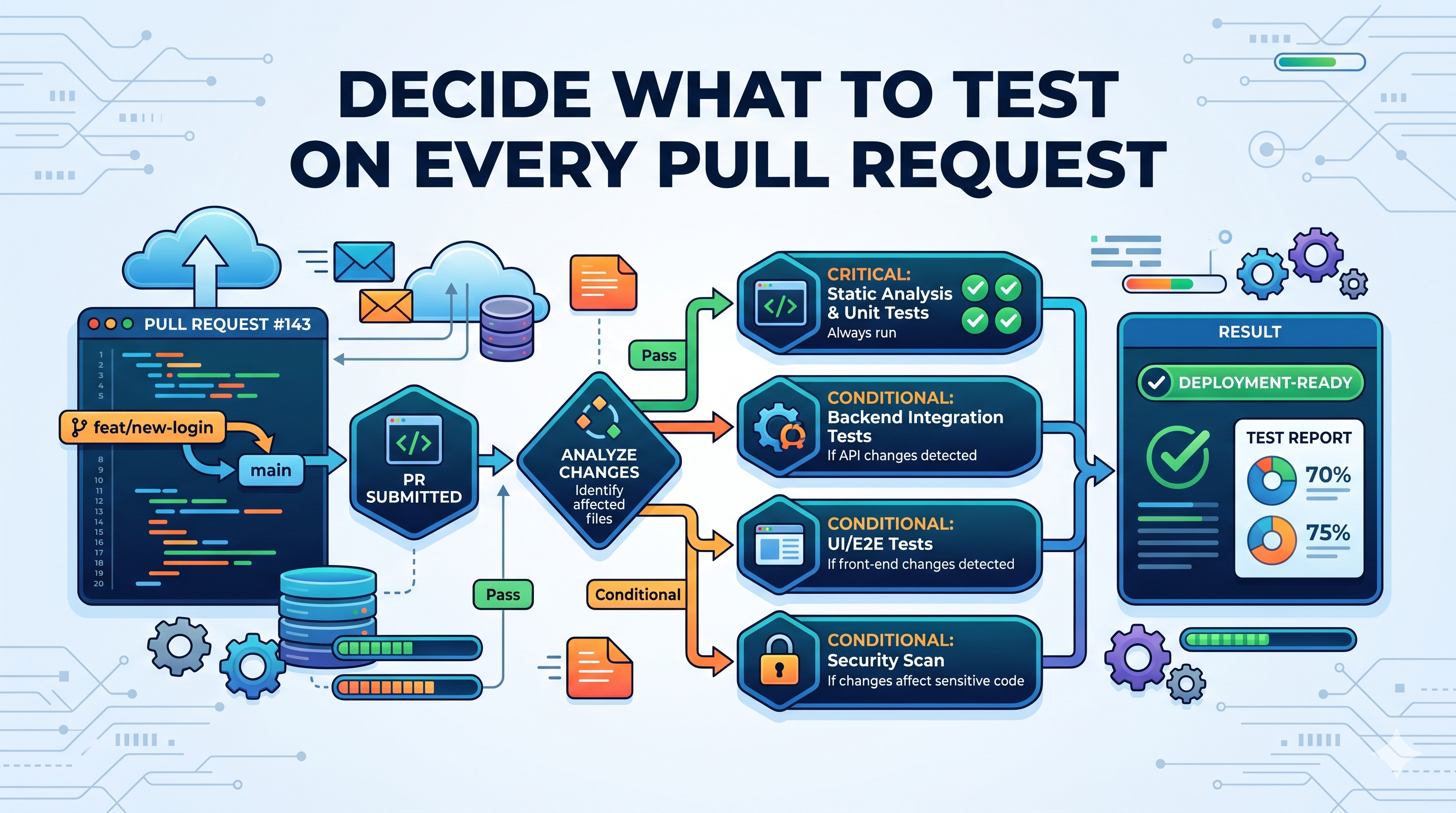
Targeted test generation: Based on all of the above, the agent generates two types of tests:
- Regression tests - validating that existing behavior still works
- Feature tests - validating that the new behavior works correctly
These tests are contextual. They test what matters for this specific change, not a generic suite that was written months ago.
No maintenance
This is the critical difference from traditional test automation.
| Traditional automation | Autonomous testing | |
|---|---|---|
| Lifecycle | Write → maintain → update → fix flakes | Generate per PR → run → discard |
| Artifact | Thousands of files in /e2e | Intelligence in the agent + diff |
| When UI changes | Broken selectors, engineer tickets | Next PR gets fresh scope |
| Best for | Stable, slow surfaces | Fast-moving product teams |
Traditional test automation: write tests → maintain tests → update tests when code changes → fix flaky tests → maintain more tests.
Autonomous testing: tests are generated per PR, executed, and discarded. The next PR gets its own fresh tests based on its own changes. There is no test suite to maintain because there is no persistent test suite.
The testing knowledge lives in the agent's understanding of your codebase, not in a folder of .test.ts files.
Implementation: How to automatically test every pull request without writing a test — GitHub Actions YAML, Playwright comparison, and O2 setup.
How DevAssure implements this
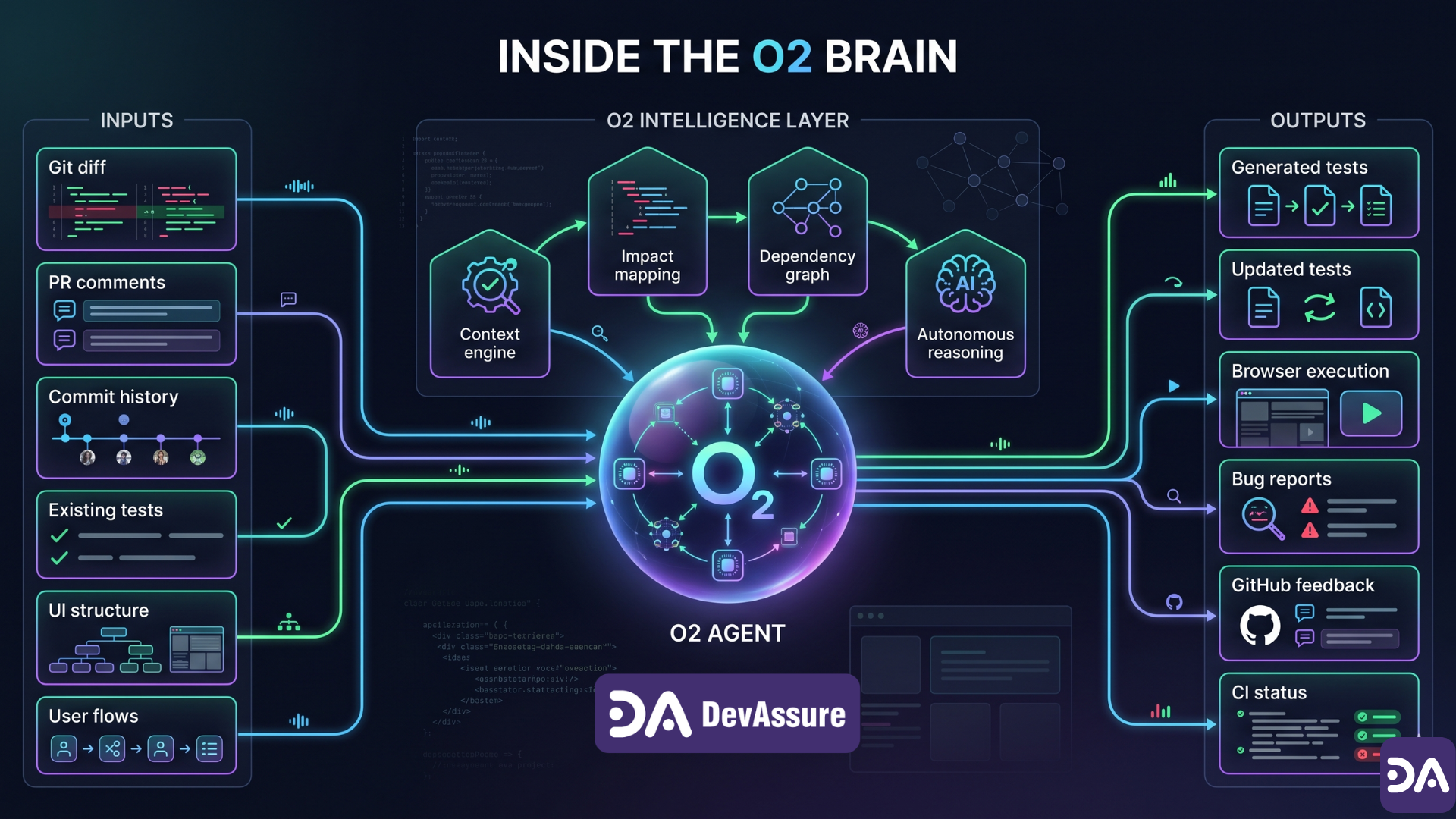
At DevAssure, we built the O2 Agent to implement autonomous testing as a GitHub Action.
The integration is one line:
steps:
  - uses: devassure-ai/devassure-action@v1
When a PR is opened, O2 executes the full autonomous testing pipeline: diff analysis → change history → impact mapping → test generation → execution → PR comment with results.
No scripts to write. No test suite to maintain. No flaky tests to debug.
What the results look like
From our early customer deployments across fintech, healthcare, and SaaS companies:
The QA engineers were not replaced. They were freed - freed from the maintenance treadmill to do the work that actually requires human judgment: exploratory testing, quality architecture, and user experience validation.
For a hands-on setup guide, see How to Set Up Vibe Testing on Every Pull Request.
Where humans still matter
Autonomous testing does not eliminate the need for human quality thinking. It eliminates the need for human quality labor.
Humans are still essential for:
Quality strategy - deciding what "quality" means for your product. Which edge cases matter most? What is the acceptable risk threshold? Where should testing investment go?
Exploratory testing - the creative, curiosity-driven testing that finds bugs no automated system would think to look for. What happens if I do this weird thing? is inherently human.
Domain expertise - understanding that in healthcare, a rounding error in dosage calculation is not just a bug - it is a patient safety issue. Understanding that in fintech, a race condition in transactions is not just a timing problem - it is a regulatory violation.
User experience judgment - a test can verify that a button works. It cannot tell you that the button is confusing, poorly placed, or unnecessary.
The model is not "AI replaces QA." The model is:
AI handles execution. Humans handle judgment.
The shift from "shift left" to "shift smart"
I do not think we need to abandon the core insight of shift left - finding bugs early is genuinely better than finding them late.
But we need to stop equating "early" with "developer responsibility." The timing was right. The mechanism was wrong.
Autonomous testing preserves the timing - tests run at the point of change, the earliest possible moment - while changing the mechanism. The agent tests, not the developer. The agent maintains, not the QA team. The agent adapts, not the test suite.
That is the shift. Not left or right. Smart.
Frequently asked questions
The principle did not - finding bugs earlier is still correct. The execution did. Teams equated “earlier” with “developers write more tests,” which overloaded engineers, inflated coverage metrics, and left production regressions unchanged.
The bottom line
Shift left asked developers to carry QA's execution load without giving them agents that could keep up. Autonomous testing keeps early feedback and drops the maintenance tax.
Shift smart with DevAssure.
- Add the GitHub Action: Marketplace listing
- Sign up for free credits: app.devassure.io/sign_up
- Questions: support@devassure.io
At DevAssure, we believe software quality should be a byproduct of great engineering - not a tax on it. O2 Agent is available on the GitHub Marketplace with $50 in free credits for 30 days.
Links
- Autonomous test execution (why scripts were the wrong abstraction): https://www.devassure.io/blog/autonomous-test-execution/
- The quiet death of the test script: https://www.devassure.io/blog/quiet-death-of-the-test-script/
- Vibe testing on every PR: https://www.devassure.io/blog/how-to-set-up-vibe-testing-on-every-pull-request/
- Why coding agents can't test: https://www.devassure.io/blog/why-coding-agents-cant-test/
- Test automation with AI agents: https://www.devassure.io/blog/test-automation-with-ai-agents/
- DevAssure O2: https://www.devassure.io/o2-testing-agent
- DevAssure: https://www.devassure.io